
Blog
Should you rent or buy? It depends on how long you'll stay
By Gabriel Kadiwa, Founder & Full-Stack Developer
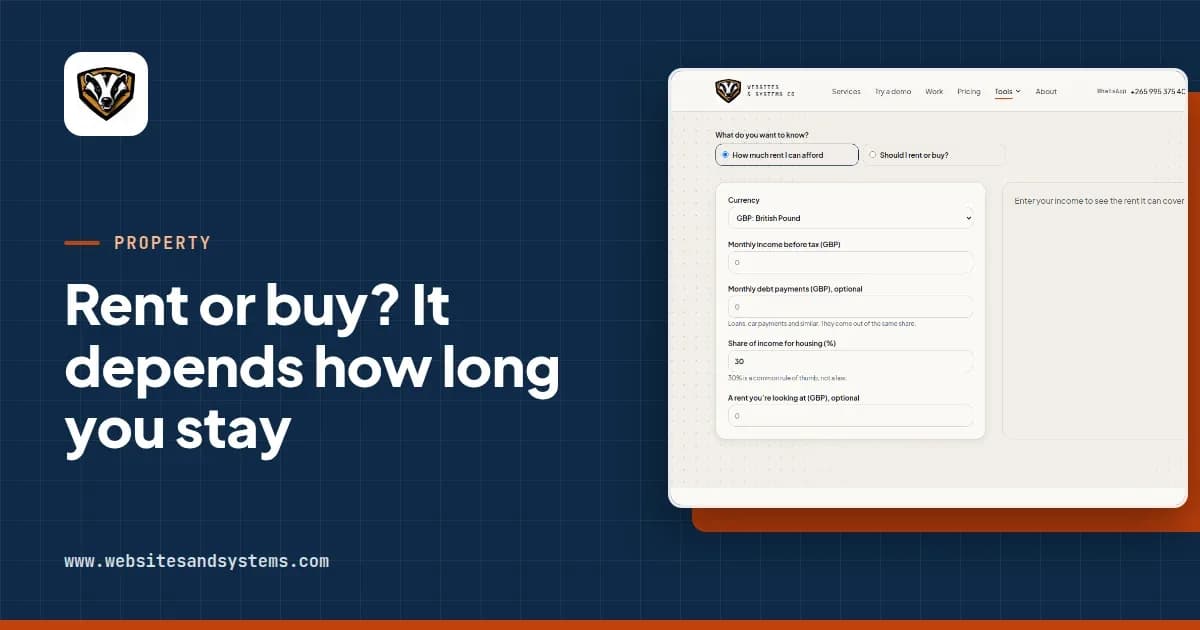
Whether renting or buying is better depends mostly on how long you'll stay, because buying has big one-off costs that take years to earn back. Our free rent calculator compares the two on your own numbers, and shows how much rent your income can cover.
Whether renting or buying is better depends mostly on how long you'll stay, because buying has big one-off costs that take years to earn back. Our free rent calculator compares the two on your own numbers, and shows how much rent your income can cover.
People tend to hold firm views on this. Renting is throwing money away, or buying is a trap. Both views are usually held by someone who hasn't done the sum.
How much rent can I afford?
A common rule of thumb is 30% of your income before tax. On US$5,000 a month, that's US$1,500 for rent. It's a guide, not a law, so the calculator also shows 25% and 35%, and takes off any debt payments you already have.
It works the other way too. Type in a rent you're looking at and it tells you the income it needs. A rent of US$1,800 needs about US$6,000 a month at 30%.
How do you compare renting with buying fairly?
Most comparisons add up the rent and add up the mortgage, then declare a winner. That misses the deposit, which could have been earning something, and the fact that a buyer owns a house at the end.
So ours treats both sides the same way. Each spends the same amount every month. Whoever has the smaller bill saves the difference, and the renter also saves the deposit and buying costs. At the end, it compares what each side owns.
What does that look like with real numbers?
Say a US$300,000 home, a US$30,000 deposit, US$5,000 in buying costs and a 6% mortgage over 25 years, against US$1,200 a month in rent. We assumed home values and rent both rise 3% a year, savings earn 4%, upkeep costs 1% of the home's value a year, and selling costs 3%.
Renting is ahead for the first four years. Buying pulls ahead after five. After ten years, buying leaves you US$35,604 better off.
Move out in year three on those numbers, and buying would have cost you. That's the whole argument in one line.
Why might your answer be different?
Because the result is very sensitive to the assumptions, and you should try a few. Change the home's growth from 3% to 1% and watch what happens.
Countries with high interest rates are a different sum altogether. If your mortgage rate is high, inflation usually is too, so raise the home value, rent and savings figures to match. The calculator will remind you.
Quick answers
Is renting throwing money away?
No. Rent buys you a home and flexibility. A mortgage also has costs you never get back, such as interest, upkeep and fees.
How long should I stay before buying makes sense?
It depends on your numbers. In our example it took five years, but the calculator will show yours.
Does it include tax?
No. Taxes on buying, selling or renting aren't included, so add any buying taxes under one-off buying costs.
Should I trust the answer?
Treat it as an estimate, not advice. Nobody knows what home prices will do, so use it to test a few outcomes.
If you run a letting or property business, we build websites for that too.