
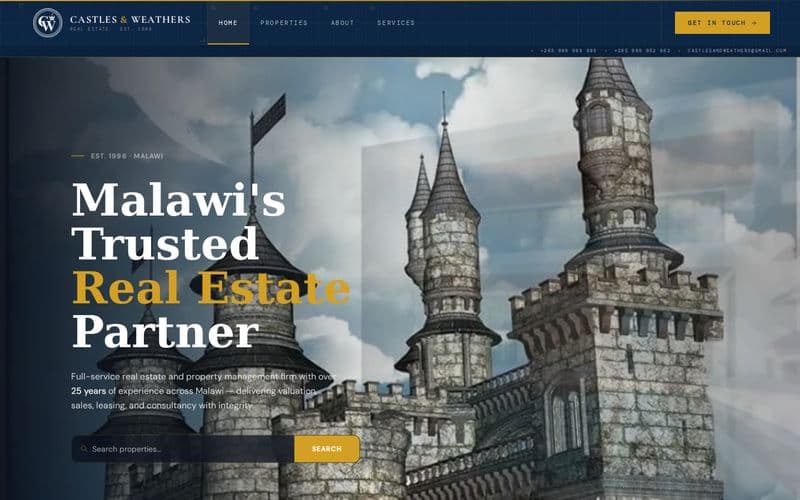
Malawi · Real estate & valuation
Castles & Weathers
Property listings in MWK & USD, managed by their own team
Read the case study →
Management systems
Case management for law firms, property & listings management for real estate, client and job tracking, and stock, in one system your team logs into.

Before
Files, deadlines and clients live in spreadsheets and people's heads.
After
One system your team logs into, shaped around how you already work. Everyone finds the file, the client or the deadline in seconds, and managers see what's happening without sending a WhatsApp to ask.
Malawi · Real estate & valuation
Property listings in MWK & USD, managed by their own team
Read the case study →

Malawi · Legal
Staff ask in plain words, the AI drafts, a person confirms
Read the case study →
A fixed-scope system (for example a booking platform or case management) starts from MWK 7,000,000 (£3,000 or US$4,000). Larger systems can be built in phases from MWK 4,500,000 (£1,900 or US$2,600) per phase. Smaller ready-scoped options are on our pricing page: a reporting dashboard from MWK 950,000 and a business management system from MWK 2,800,000. Every project gets a fixed quote after discovery, so the price is agreed before we start.
For custom systems, discovery costs MWK 900,000 (£380 or US$520): 1–2 workshops, a written scope and a clickable prototype of your system. If you go ahead with the build, the fee is credited against it.
It depends on what we build. Before you commit, you get one written proposal with what we'll build, the timeline and the cost. During the build you see progress every week or two.
The client file is on Grace's laptop. The deadline is in a WhatsApp group from March. The latest version of the spreadsheet is called "FINAL final (2)". Everybody works hard, and still somebody spends Tuesday morning looking for something.
That's not a people problem. It's a system problem. And it's fixable.
We build around the work you actually do. The most common ones:
Case management for law firms. Every case in one place behind a private login: parties, documents, dates and notes. We're building an AI-assisted legal case management system for a Malawian law firm where staff can ask for things in plain words. It can fill in a document from a chat request (staff check the fields and confirm before anything is saved), find a case or file and jump straight to it, pull up data, and summarise a case. More on that on AI & automation.
Property and listings management. Listings with photos, prices in MWK and USD, and an admin panel the firm's own team uses. That's what we built for Castles & Weathers, a real estate and valuation firm established in 1996.
Client and job tracking. Who asked for what, who's doing it, and how far it's got. Our own project tracker works this way: plan the week on Monday, check in on Friday, and it flags any task with no owner.
Stock. What you have, where it is, and when you're running low, without the Friday-afternoon count.
Sometimes you should, and we'll say so. But off-the-shelf tools are built for an average business that doesn't exist. Malawian organisations often need two currencies, mobile money, documents in a local format, and something that copes with a slow connection. If you find yourself bending your whole process to fit the software, a system built around your process usually pays for itself in the hours it gives back.
Carefully, and in small pieces.
If the budget is tight, a phased build starts with the part that hurts most and adds modules later.
It sits behind a private login, each person sees only what their role allows, and important actions can be logged. Your data belongs to you, and it isn't shared or used for anything else.
Discovery and demo, fixed-scope systems, phased builds and monthly retainers are all priced on the pricing page. See also Custom Systems, or book a free discovery call and bring your worst spreadsheet.
Custom Systems
Booking platforms, case & property management systems and dashboards built around how your team works. Try a live demo, then book a discovery call.
From MWK 7,000,000, £3,000 or US$4,000 · discovery & demo from US$520
Booking systems
Customers pick a service, date and details online. You get it instantly on WhatsApp and email, and it is saved in a dashboard.
AI & automation
Practical AI inside your systems: drafting, summarising case files, searching documents and answering staff questions from your own data. Data stays private; humans approve outputs.