
Blog
What did 7 million simulated trades teach us about trading?
By Gabriel Kadiwa, Founder & Full-Stack Developer
Mostly that costs, exits and patience matter more than entries. Here are ten lessons from our backtests and demo trading, each with the numbers behind it.
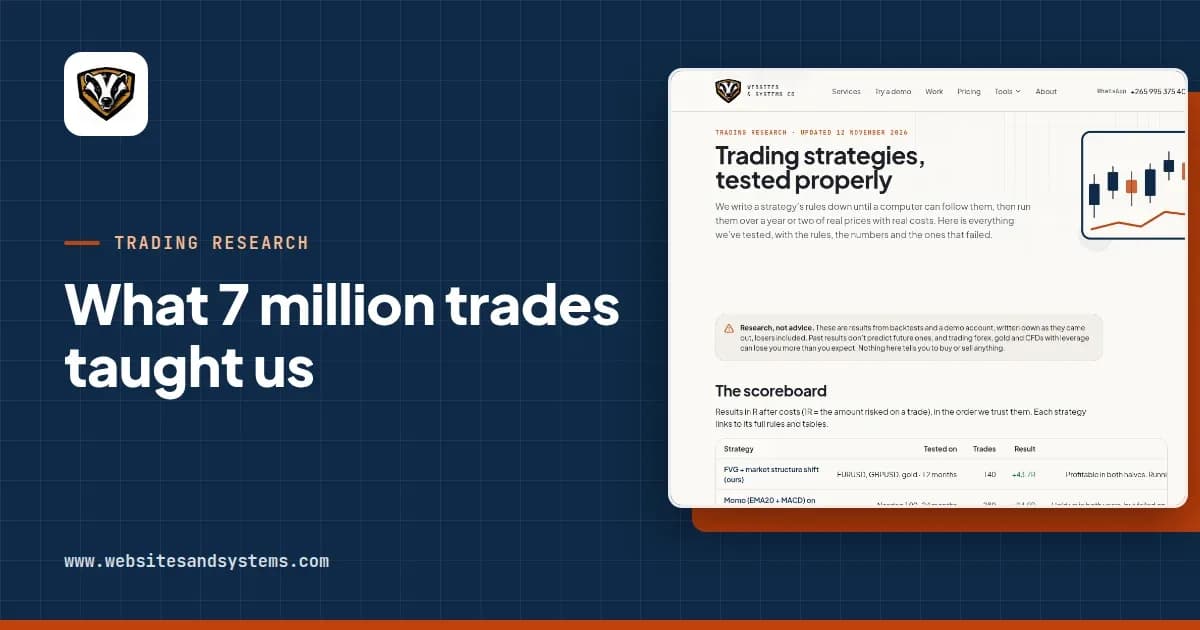
Mostly that costs, exits and patience matter more than the entry signal everyone argues about. Between our own FVG strategy, two YouTube strategies and a lab of 828 settings on 20 markets, we've simulated about 7 million trades. These are the lessons that kept coming back, with the numbers behind each one. The full list is on our trading tips page.
1. Count the costs first
Our strategy made +54R in a year before extra costs and +33R after charging 1 pip a trade. A version that took half its profit early fell from +32R to +11R. On 5-minute and 15-minute charts, costs turned most strategies from small profits into large losses. Always test with the spread and commission your real account will pay.
2. A high win rate isn't the goal
Taking half off at the first target raised our win rate from 44% to 58% and cut total profit by about 40%. The few trades that run past 2R pay for everything else. Judge a strategy by profit per trade and drawdown, not by how often it wins.
3. Split every test in two
Our first six-month test showed +40R and 72% winners. Over twelve months, the first half made +4R and the second +39R. If one half carries all the profit, expect long flat stretches, and size your risk for them.
4. Expect losing months
Even in a profitable year we had a −10.8R month and two losing quarters. If a losing month would make you abandon the plan, the risk per trade is too high.
5. Distrust clever filters
Skipping setups with an opposing gap in the way gave an 80% win rate over six months. Over twelve months it was the worst option we tested, with 15 losses in a row. A filter has to earn its place over the longer test.
6. Write the rules down precisely
When we coded two popular YouTube strategies, parts of them turned out to be judgement calls. Once every rule was fixed, neither showed an edge. If you can't write a rule precisely, you can't test it, and you can't follow it consistently either.
7. Shorter timeframes aren't better
Across 828 settings and 20 markets, 5-minute and 15-minute charts lost money almost everywhere. 1-hour and 4-hour charts were close to even. More trades means more costs and more noise.
8. One great market isn't a strategy
Our best lab result worked on the Nasdaq 100 and failed on 17 of 19 other markets. A setting that works on one market only is more likely luck than an edge, until it keeps working going forward.
9. Demo first, and keep a journal
Our strategy has traded a demo account since October 2026, with every trade journalled and charted. A month in, it's slightly down. Live results drift from backtests, and only a forward test shows by how much.
10. Risk an amount that lets you keep going
At 1% a trade, our worst drawdown of about 12R is a 12% fall. At 5% a trade, the same run of losses would take close to half the account, and you'd need nearly double back just to recover.
Read the research
- FVG strategy: rules and 12-month backtest
- Two YouTube strategies, tested
- Strategy lab: 828 settings on 20 markets
The backtester and the trading bot are software we built. If your business needs a system that turns rules and data into decisions, book a free 30-minute discovery call about a custom system.
This is research, not financial advice. Trading with leverage carries a high risk of losing money.