
Blog
What should a tenancy agreement include?
By Gabriel Kadiwa, Founder & Full-Stack Developer
A tenancy agreement should say who the landlord and tenants are, the address, the dates, the rent, the deposit, who pays which bills, who repairs what and how either side can end it. Our free tenancy agreement template covers all of that, and you can download it as PDF or Word.
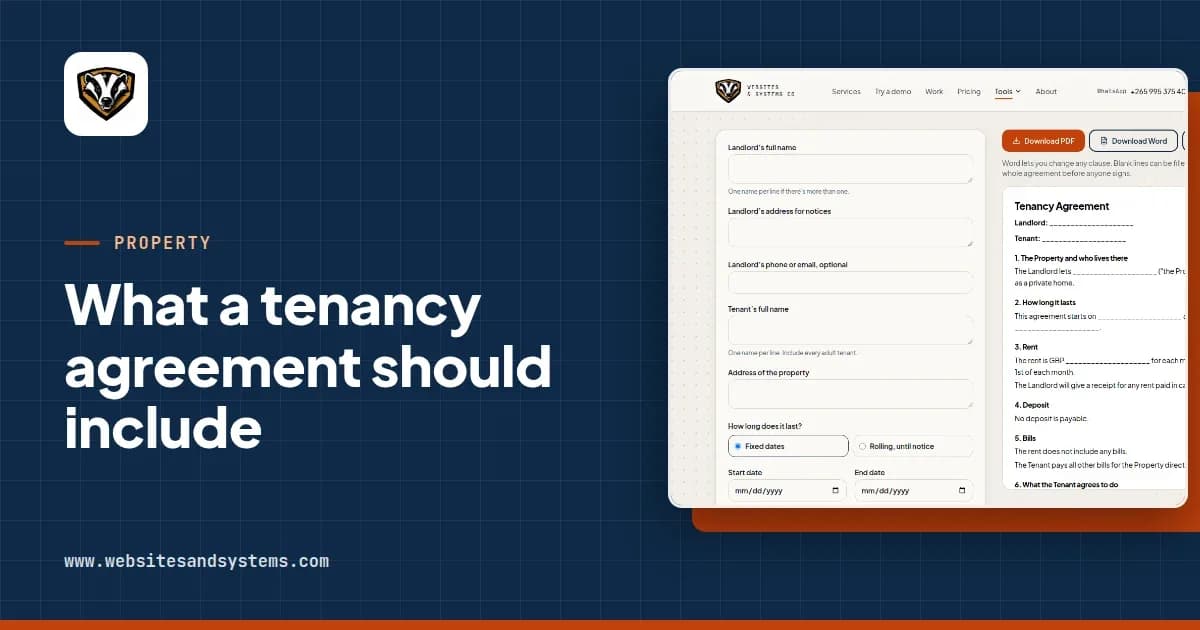
A tenancy agreement should say who the landlord and tenants are, the address, the dates, the rent, the deposit, who pays which bills, who repairs what and how either side can end it. Our free tenancy agreement template covers all of that, and you can download it as PDF or Word.
A word before we go on: I build software, not legal arguments. This is a template and a plain guide, not legal advice. Tenancy law differs from one country to the next, and the law beats whatever your agreement says, so check it against your local rules.
What goes in a tenancy agreement?
The basics are the same almost everywhere:
- The full names of the landlord and every adult tenant
- The address of the property, and an address for sending notices
- The start date, and the end date if there is one
- The rent, how often it's paid and when it's due
- The deposit, and what it can be used for
- Which bills are in the rent and which aren't
- What the tenant must look after and what the landlord must repair
- When the landlord can come in
- Whether pets are allowed
- How either side ends the agreement
Most arguments between landlords and tenants come down to something that was never written down. Ten minutes on a form now is cheaper than the same discussion later, with less goodwill.
What changed in England in 2026?
Quite a lot. Since 1 May 2026, new private assured tenancies in England are periodic, which means they have no end date. Section 21 notices can no longer be used, and a landlord will usually need a court order on set grounds to end a tenancy.
Landlords must also give tenants certain written information before they sign or agree the tenancy. The list is set by regulations, and it covers the rent, the deposit, the notice a tenant must give, how a landlord ends a tenancy, and the landlord's duties on repairs, safety, disability adaptations and pets. GOV.UK says the fine for not doing this can reach £7,000.
An old fixed-term agreement won't do the job, so we made a separate tenancy agreement for England that covers each required item. It isn't for Wales, Scotland or Northern Ireland, which have their own rules.
What about South Africa?
The Rental Housing Act has specific rules on deposits. The landlord must keep the deposit in an interest-bearing account, and the interest belongs to the tenant. Both sides inspect the property together before moving in and again shortly before the lease ends, and the Act sets time limits for the refund.
Our lease agreement for South Africa has those rules written in.
What if my country isn't listed?
Use the general template. It works in any currency and covers the usual terms, and it says that local law applies where the two conflict. In many countries that's enough for an ordinary let, but have a local lawyer look at it if the rent is high or the terms are unusual.
Quick answers
Do I need a lawyer?
For an ordinary let, many landlords don't use one. If the rent is high, the terms are unusual or something has gone wrong, a local lawyer is worth the fee.
Can I change the wording?
Yes, download the Word copy and change any clause. Don't remove rights the law gives the tenant, because those clauses usually can't be enforced.
Does it need witnesses?
That depends on the country and the length of the tenancy. The template includes witness lines in case you need them.
Is my information saved?
No. The template runs in your browser, and nothing you type reaches us.
If you're letting several properties and tired of chasing paperwork, talk to us about a website that does more of it.